
Not everyone needs to chew in order to eat, and the toothless animals below are the prime examples of that. Edentates is a single order of animals that have very few teeth or no teeth at all. The word comes from Latin roots that mean “missing tooth”. Edentate animals have their own unique way to ingest food, and we will find out more below. Anything is possible in the animal kingdom, and we are going to check out 4 interesting toothless animals today.
1Anteater

Scientific Name Order: Pilosa
Anteaters are one beautiful animals, and one of the most well-known edentates out there. It has very dense fur that covers the entire body, with a long tail that is also covered with coarse hair. There are 4 anteater species, and the giant anteater is the biggest species in the family, growing up to 2 meters long. All anteaters have small mouths, and they have no teeth. What compensates the teeth for feeding is the thin, long tongue that is coated with sticky saliva. When feeding, they use their large claws to break into the mounds of ants and termites. Once the insects scurry out, they will use their tongue to lick the prey and slurp.
Endemic to the New World, anteaters live on the mainland from southern Mexico to Northern Argentina. Their habitats are dry tropical forests, grasslands, rainforests, and savannas; where meals are abundant. This animal has special skills to feed on small insects, even the dangerous ones. To avoid bites and stings from the prey, they feed by licking up large numbers of ants and termites extremely quickly. So quick that the insects have no time to fight for their lives because anteaters can actually flick their tongue up to 150 times per minute. Normally, an anteater only spends around a minute at a nest before moving on to another. However, it visits up to 100 or more nests per day to eat hundreds of thousands of insects it needs. The best part? Anteaters never destroy a nest, because they will come back and feed again in the future.
2Baleen Whale

Scientific Name: Mysticetes
The mysticetes consists of 4 families: the gray whales, the pygmy right whales, the right whales, and the rorquals. There are 16 species of baleen whales, including blue whales, gray whales, humpback whales, etc. While being the largest animals on the planet, they mainly feed on small organisms such as small fish and zooplankton. Whales in this group do not have any teeth; instead, they have flexible and comb-like plates made of keratin. These plates are called “baleen”, and they hang from the upper jaws of the whales. When feeding, the whales use these plates to filter tiny creatures like krill and plankton from mouthfuls of ocean water. This is how the world’s largest creatures consume tons of food every day without the need for biting or chewing.
Just like human hair and nails, baleen grows and wears continuously. Depending on the species, baleen whales have between 150 and 400 baleen plates on each side of their mouth. The length of the baleen is also different in different whale species. It is one meter in adult blue whales, 90 centimeters in fin and humpback whales, and 30 centimeters in minke whales. The longest baleen title belongs to the bowhead whales, which is over 4 meters long. Generally, baleen is black or brown in color, except in minke whales, where it is cream in color. In the past, people used dried baleen to add rigid structure to items like buggy whips, corsets, and umbrella ribs. Alaska Native people also used baleen to make baskets, cultural art, and tools.
Fun Fact
Things are a bit tricky when it comes to baleen whales, and this is where it gets interesting. Whales were the first mammals to evolve baleen. Just like land-dwelling animals, whales did have teeth to chew their food at first. As oceans changed and animals evolved, some whales began feeding by suction, and baleen filter feeding became a new feeding strategy. Proof of teeth still exists to this day, as tooth buds still appear at the embryonic stage of baleen whales. However, those tooth buds never develop teeth.
3Platypus
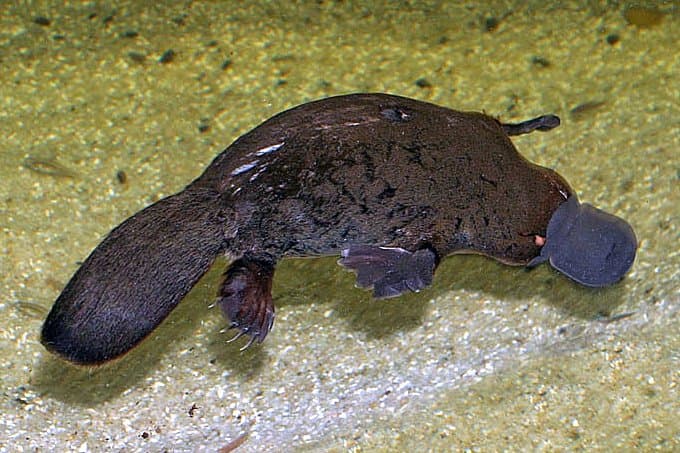
Scientific Name: Ornithorhynchus Anatinus
Edentates are special in their own ways, and the platypus is something of its own as well. Platypuses don’t have teeth, but there is a series of plates that they use to crush and chew their invertebrate prey. As a fetus, a platypus does have teeth growing, but the teeth are reabsorbed back into the skull later. So when a platypus is born, it has vestigial teeth that help it break out of its egg. What a puggle has is one premolar, two molars on each side of the upper jaw, and two to three molars on each side of the lower jaw. As soon as it leaves the care of its mother when it is 3 to 4 months old, it loses these teeth.
Adult platypuses have 4 keratinized grinding pads that are at the back of their mouth. There are two plates on its upper and two plates on the lower part of its bill. These plates are flat but rough, and they provide a flat surface for food mashing. When hunting, it closes its eyes, ears, and nostrils while underwater, and relies entirely on the electroreceptors in its bill. The prey that the bill detects are invertebrates like insect larvae, shrimps, and worms. Since a platypus does not have a stomach, the food that it crushes inside its bill will go directly to the intestines. And if we look further back into the prehistoric ancestors of the platypus, they did have well-formed functional teeth. Considering everything was massive at the time, the ancient platypuses needed teeth to crush shells of their prey
4Whale Shark

Scientific Name: Rhincodon Typus
Technically, whale sharks are not strictly edentates, but they are also filter feeders. Unlike baleen whales, whale sharks do not have baleen plates. They capture crustaceans, fish eggs, plankton, and small fish using large gill rakers, and they don’t bite or chew their food. Gill rakers form over 20 filter pads in a whale shark’s mouth to sieve water. They have fine mesh that blocks anything larger than 2 to 3 millimeters to retain food and let the water out. The cool part is that the shark performs a “cough” motion to flush the filter clean when debris builds up.
Do whale sharks have teeth? Yes, more than most animals do. Whale sharks actually have about 3,000 tiny, hooked teeth arranged in around 300 rows inside their jaws. However, these teeth are completely vestigial, and they are only less than 6 millimeters long. Simply put, those 3000 teeth are useless, and they are just evolutionary remnants from their predatory ancestors.
The teeth don’t end there; whale sharks also have teeth on their eyeballs. So much for edentates, right? These gentle giants have thousands of dermal denticles (microscopic, tooth-like scales) covering their eyeballs. This is because they lack eyelids; those eyeball teeth act like a shield to protect their eyes from damage and debris. Speaking of eyes, whale sharks can retract their eyeballs into their head using a unique cartilage bar and attached muscles. They do that when facing serious threats or to improve their forward vision.
Related: Animals With Rectangular Pupils