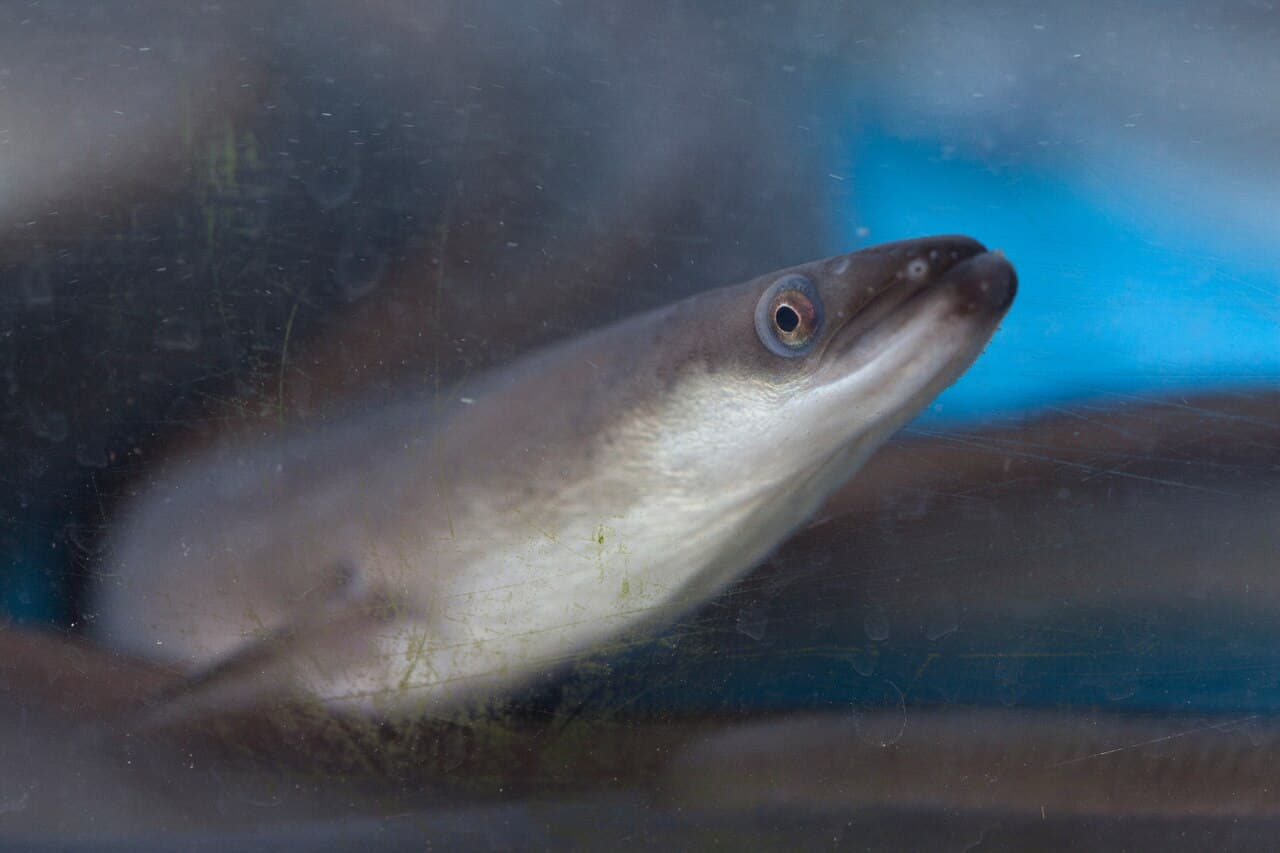
Last time, we talked about the largest marine eel species. Now, let’s talk about the largest freshwater eel species today. Probably smaller than the ones that conquer the oceans, some freshwater eels can reach some impressive lengths. There are 9 of them below, let’s see which one is the most fascinating to you.
9Tire Track Eel
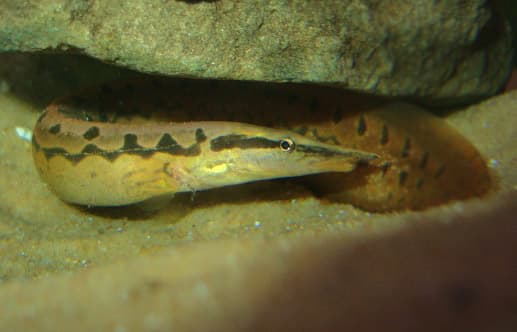
Scientific Name: Mastacembelus Armatus
Length: 91 centimeters
Goes by many names such as freshwater spiny eel, marbled spiny eel, or zig-zag eel, the tire track eel looks like its name. A tire track eel is dull brown in color, with a dark beige back and silver-beige head. What earns its name is the dark zigzag lines that form a distinct reticulated pattern on its body. It also has a pattern of black dots on each side of its fin that mimics its environment for camouflage. This species can reach up to 91 centimeters long in the wild, but not longer than 51 centimeters in captivity. Speaking of captivity, this large freshwater eel species is quite popular among hobbyists due to its docile nature.
Tire track eels are native to the riverine systems of the Indian Subcontinent, South China, South Asia, and Southeast Asia. They thrive in coastal marshes, highland streams, lowland wetlands, rivers with rocky or sandy riverbeds, and still waters. In those habitats, they forage for benthic insect larvae, earthworms, small fish, and some submerged plant material. Their diet changes depending on seasonal availability of food sources. These slimy fish hide under rocks or the sandy substrate during the daytime, and emerge at night to feed. And speaking of feeding, these eels are actually popular as food sources. Local residents along the rivers prepare them in various ways such as barbecue, curry, dry, fry, pickle, smoke, and more.
8Swamp Eel
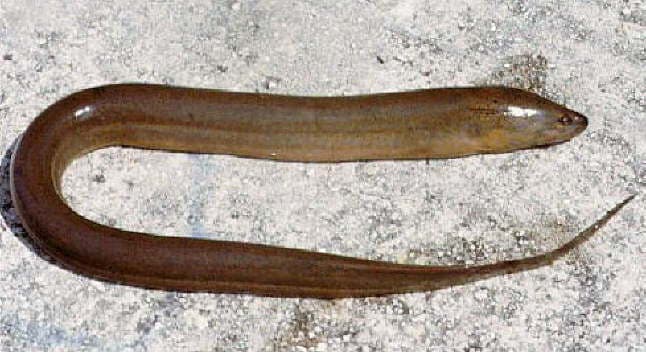
Scientific Name: Monopterus Albus
Length: 1 meter
This eel species is long and slender, and it lacks pectoral and pelvic fins. Its coloration is dull olive green to vibrant brown, often with a slightly glossy appearance. Swamp eels belong to the Synbranchidae family, and most species possess the special ability to breathe air. This allows them to survive in low-oxygenated water and to migrate overland between ponds on wet nights. These eels are common in damp places, marshes, ponds, and rice paddies where they can bury themselves in the mud. So during the day, they burrow themselves deep into mud or thick vegetation to hide from other animals. They feed on amphibians, fish, and invertebrates. Individuals are aggressive when they encounter prey, and they are also aggressive toward other Asian swamp eels. These eels are solitary, and they only interact with each other during mating times.
In the Jiangnan region of China, people eat swamp eels as a delicacy, often as a casserole or stir-fry. While in Indonesia, swamp eels are a great protein source, and people stir-fry them with sambal hot chili sauce. As for Assam and Bangladesh, people cook them with curry.
7Fire Eel
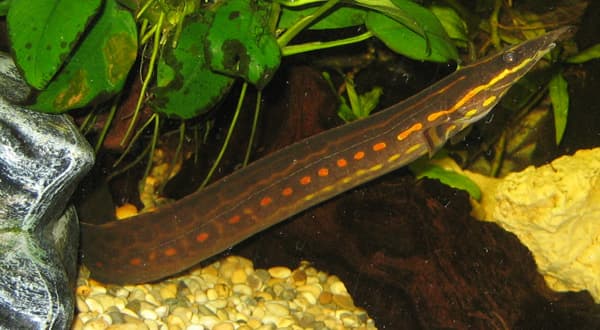
Scientific Name: Mastacembelus Erythrotaenia
Length: 1 meter
The fire eel is the largest of them all in the spiny eel family, reaching one meter long. Its base color is dark brown or dark gray, and its belly has a lighter shade of the same color. The distinctive feature of this large freshwater eel species is the bright red lateral stripes and spots on its body. Fire eels are bottom dwellers that inhabit floodplains and slow-moving rivers with a muddy bottom. They spend their daytime burying in the riverbeds, and come out at night to feed on detritus, invertebrates, plant matter, and smaller fish. It is native to Southeast Asia, but its population is declining in parts of Cambodia and Thailand due to overfishing.
6American Eel
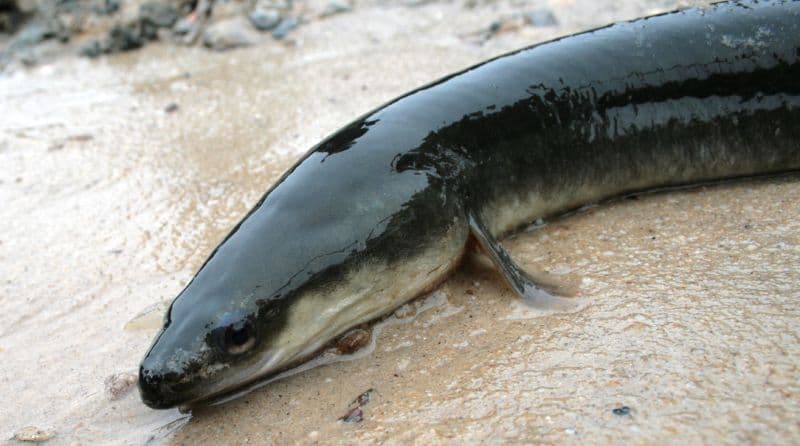
Scientific Name: Anguilla Rostrata
Length: 1.2 meters
An American eel has an elongated and snake-like body, with a long and conical head. It has small eyes, and its mouth has terminal jaws with small teeth. Normally, American eels can grow up to 1.2 meters, and females are larger than males. Females are also light in color, and have higher fins and smaller eyes. This slimy fish lives along the Atlantic coast, living in all accessible freshwater such as lakes and streams. As bottom dwellers, they hide in burrows, masses of plants, snags, and tubes in muddy lakes, rivers, and streams. With their keen sense of smell, they depend almost entirely on scent to find food. Their most common food includes crustaceans, small fish, worms, and other macro-invertebrate insects.
5European Eel
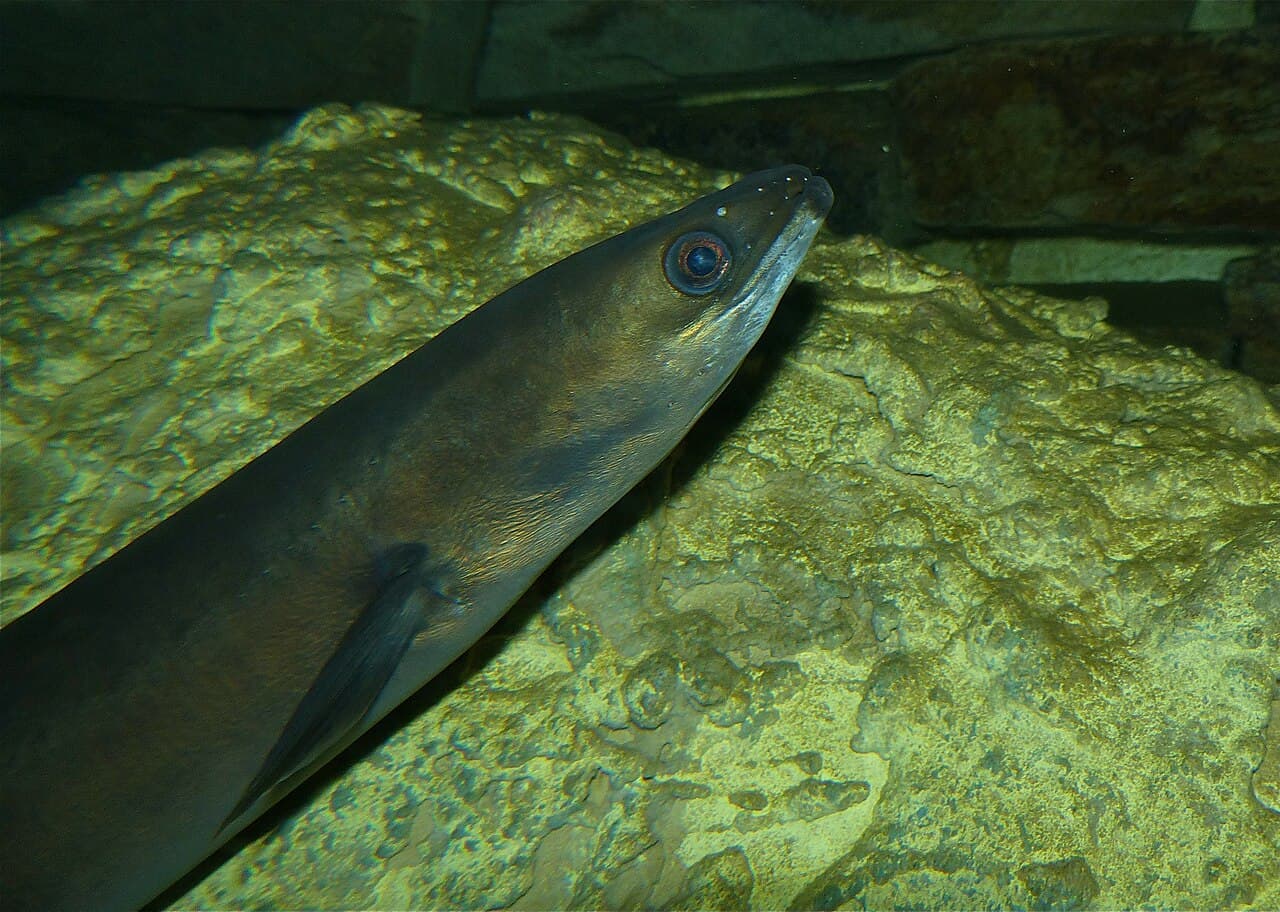
Scientific Name: Anguilla Anguilla
Length: 1.3 centimeters
European eels are usually around 80 centimeters long, but there are individuals that reach up to 1.3 meters. One fascinating thing about this eel species is that it can live very long. The average lifespan of a European eel is between 15 and 20 years. However, one specific specimen known as the Brantevik Eel lived for 155 years. But most captive specimens usually live for around 80 years only.
This large eel species has a wide population across Finland and Russia, all the way down to Egypt and Morocco. Across their ranges, they feed on crustaceans, carrion, insects, mollusks, and worms. The European eel is a critically endangered species, and there are many factors that cause its declining population. Some of the main reasons are habitat loss due to hydroelectric dams, overfishing for human consumption, parasites, and pollution.
4Japanese Eel
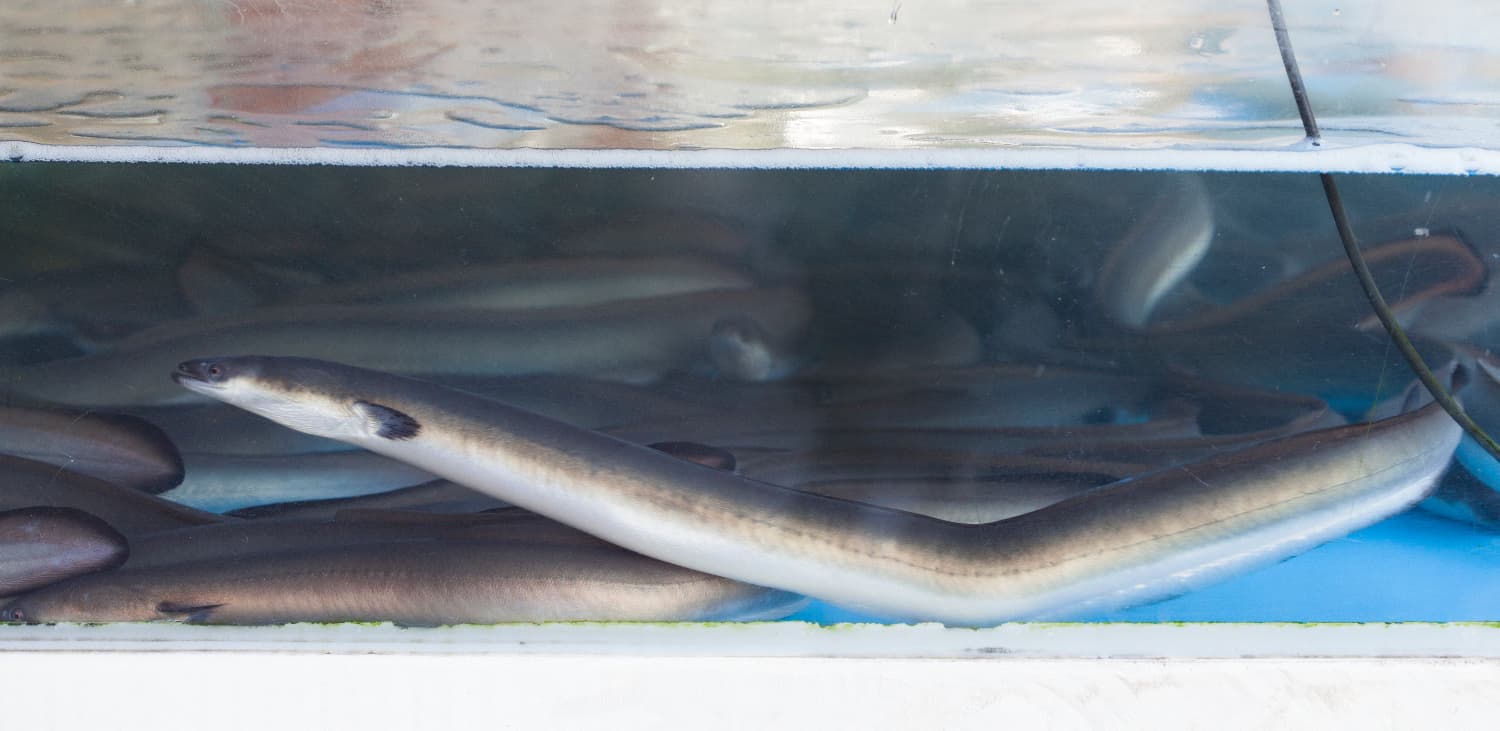
Scientific Name: Anguilla Japonica
Length: 1.5 meters
The Japanese eel has an elongated and cylindrical body just like any eels out there. It has a short and narrow head and blunt snout, and females are longer than males. Generally, they grow between 99 and 130 centimeters, but there are larger individuals that reach 150 centimeters. This eel species is a very important part of food culture in Japan, as kabayaki, sushk, unadon, unajū, and more. This famous eel species has a wide distribution across China, Korea, Japan, Taiwan, Vietnam, and the northern Philippines. It inhabits freshwater and estuaries. Unagi is catadromous, meaning it spawns in the sea but lives most of its adult life in freshwater.
They live in different habitats in different stages of life. In their juvenile and growth stages, they transform into glass eels and elvers, and there are 3 distinct habitats. Estuarine eels remain in brackish water zones where rivers meet the sea. River eels go to inland rivers, mountain lakes, and streams to live in complex freshwater habitats with high river fractals, mud, and rocks. Sea eels skip freshwater entirely, and spend their entire growth phase in coastal marine waters. Regardless of their habitats, they are all nocturnal and shy. Therefore, they hide beneath logs and rocks or burrow into estuarine bottoms and muddy rivers during the day.
3Australian Longfin Eel
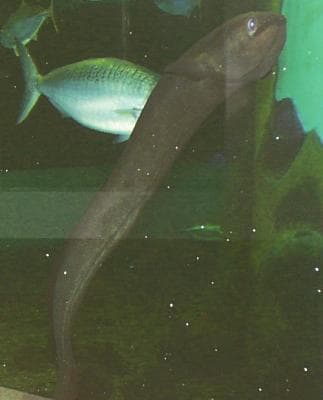
Scientific Name: Anguilla Reinhardtii
Length: 1.7 meters
Here we have the largest freshwater eel species in Australia, measuring up to 2.6 meters. Females are larger than males, so they are usually only around 1 meter long at most. It has a brownish-green or olive-green back and sides, with small darker spots or blotches all over its body. This eel has a wide head and thick lips, and the rest of the body is smaller than the head. The population of this eel is found across eastern Australia, Lord Howe Island, New Caledonia, and New Guinea. They live in various freshwater habitats such as creeks, dams, lakes, lagoons, rivers, and streams. Their diet consists of aquatic vertebrates, fish, small birds, and turtles.
2New Zealand Longfin Eel
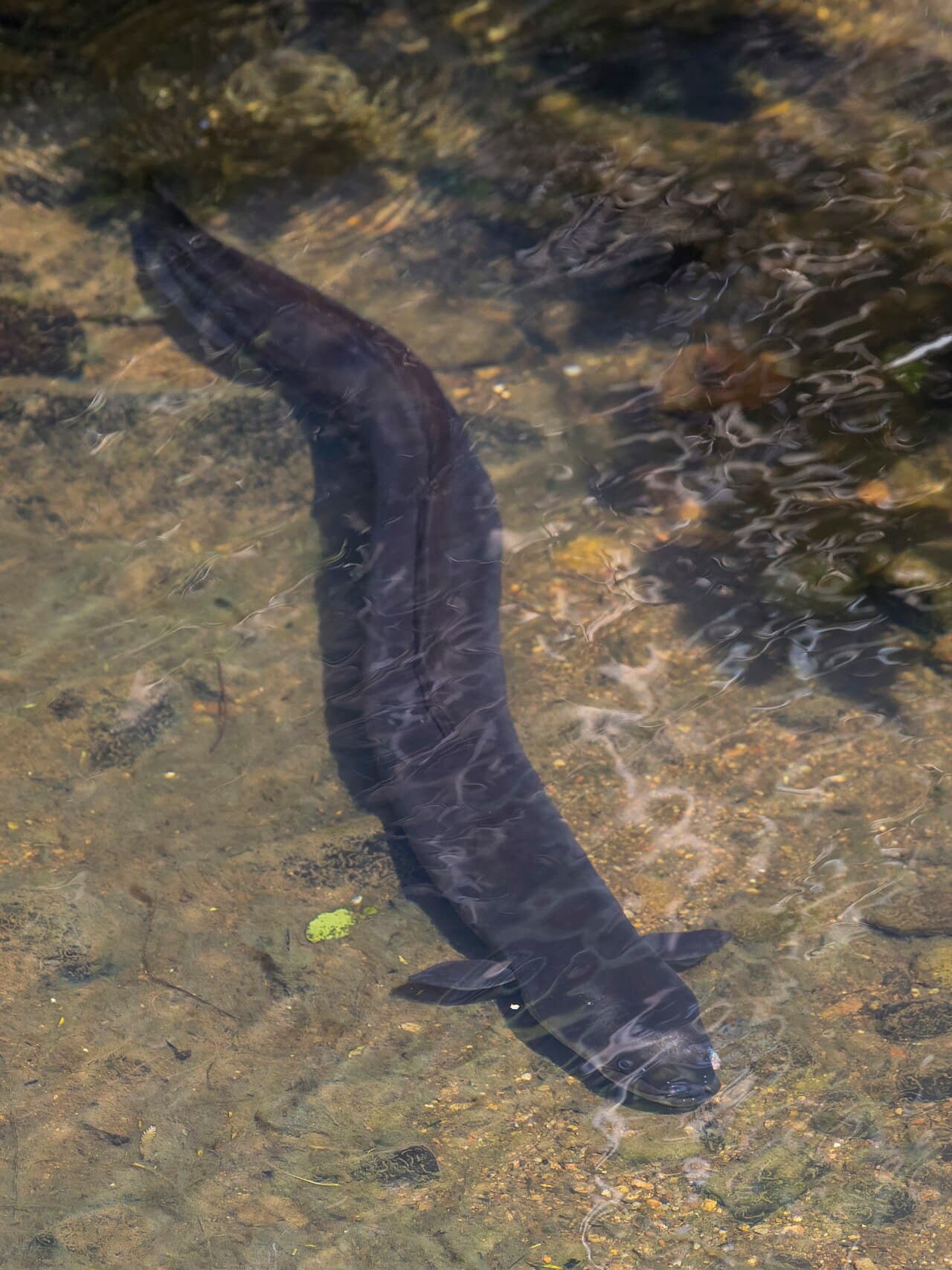
Scientific Name: Anguilla Dieffenbachii
Length: 2 meters
This is the largest freshwater eel species in New Zealand, and the only endemic species. A female New Zealand longfin eel is larger and longer, reaching up to 2 meters long. It has a large mouth filled with rows of small, white, and sharp teeth. This eel species also has a long lifespan, living anywhere from 20 to 60 years. New Zealand longfin eels have a wide distribution in lakes and rivers across the country. They have an omnivorous diet, and they are opportunistic feeders; they feed on fish, insect larvae, and snails. What’s interesting is that this eel migrates to an unknown site in to the tropical Pacific Ocean to breed at the end of its life. They can also travel over land by breathing through their skin, and this is how their population spreads throughout New Zealand.
1Giant Mottled Eel
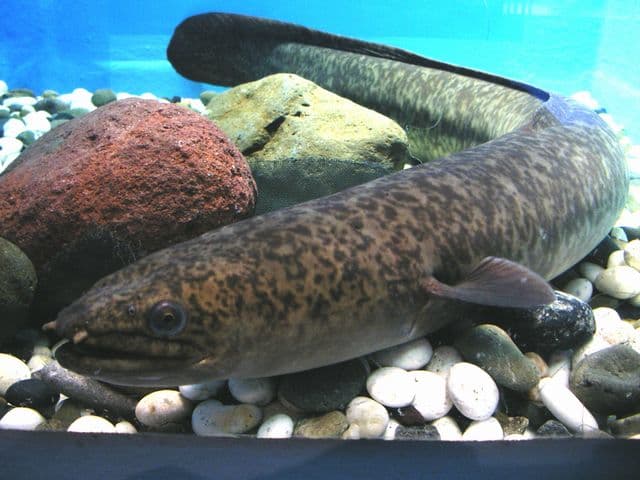
Scientific Name: Anguilla Marmorata
Length: 2 meters
The giant mottled eel aka marbled eel is the largest freshwater eel species in the world. Females can reach up to 2 meters, while males are only about 1.5 meters long. It has a cylindrical body, with small, oval-shaped scales that are embedded in the skin. What’s unique about it is that it has a mottled color. Adults are yellow with a greenish-brown to black marbling on their back, and the belly is white. The lifespan is also pretty long; they can live up to 40 years.
This eel species lives in the Indo-Pacific and adjacent freshwater habitats. Adults are demersal, and they live on the bottom of fresh to brackish waters in lakes, rivers, and tributaries. Being carnivorous, marbled eels feed on bony fish, crabs, frogs, and shrimps. These eels spend their adult lives in freshwater or estuarine habitats, then migrate to the ocean to reproduce. The hatchlings drift in ocean currents until they reach estuaries as glass eels. Then they migrate upstream into freshwater as elvers, spending about 20 years maturing, before repeating the cycle again.
Related Post: Longest Marine Eel Species