
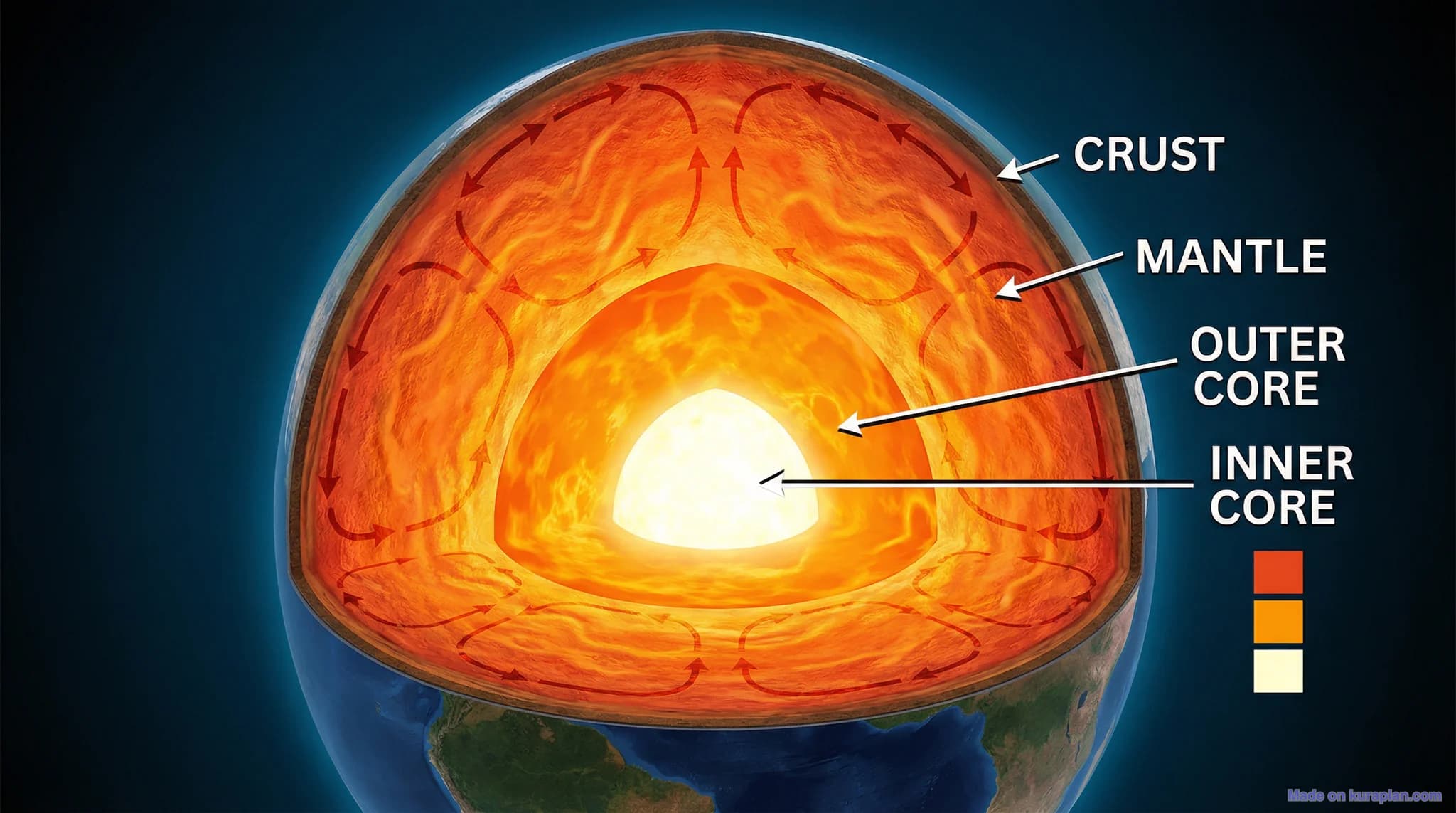
Our home planet formed about 4.5 billion years ago, and Earth’s layers are what we are going to talk about today. This fifth-largest planet is composed of 4 main layers, including an inner core, outer core, mantle, and crust. The crust is the layer that we live on, and the deeper the layer is, the hotter it gets. Now, let’s go into detail about each of the Earth’s layers and learn a bit more about them.
1Crust
The Earth’s crust is the lightest and most buoyant rock layer, covering 41% of the Earth’s surface. However, a quarter of that 41% is under the oceans. The average thickness of the Earth’s crust is about 15 to 20 kilometers, and it is the thinnest amongst the other layers. There are two distinct types: continental and oceanic. Continental crust is about 25 to 70 kilometers thick, but the crust is thicker in some places. In the Altiplano, the eastern Baltic Shield, and the Tibetan Plateau, the crust is 50 to 80 kilometers thick. This layer is mostly composed of less dense and more felsic rocks, such as granite. As for the oceanic crust, it is 5 to 10 kilometers thick, and it is composed of denser and more mafic rocks such as basalt, diabase, and gabbro. Also, the crust is thickest under young mountain belts, called orogenic belts.
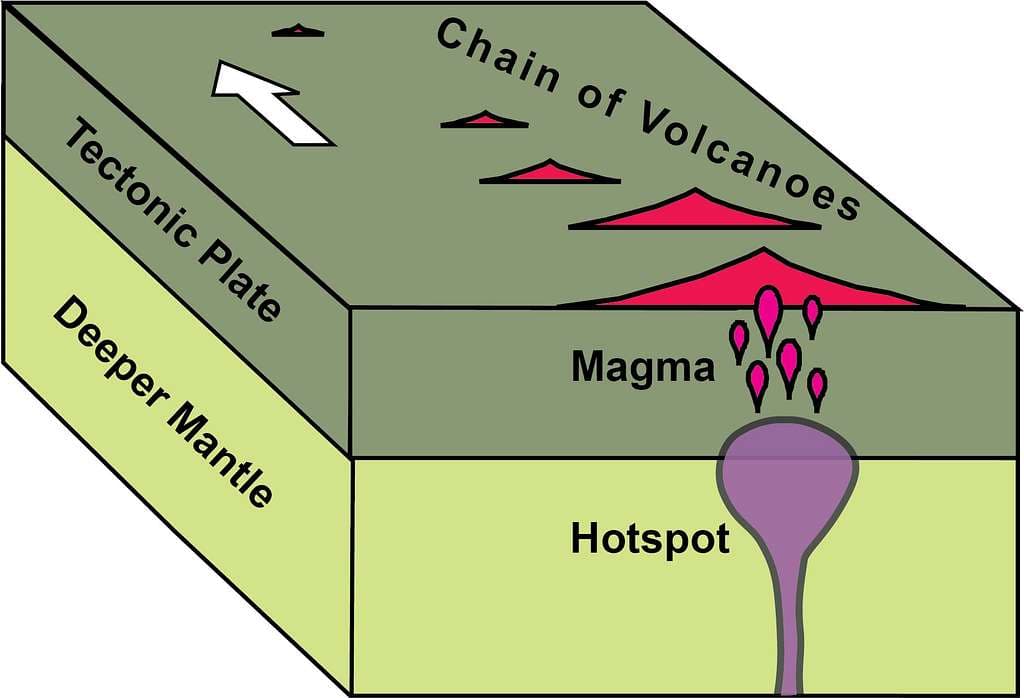
Then we have the lithosphere that is divided into several tectonic plates that can move. Do you know how plates move? Plate movements occur due to slow flows in the mantle and are driven by heat rising from the Earth’s interior. This movement along the plate boundaries can also trigger earthquakes and volcanic eruptions. Plate collisions are also a thing, where a plate with oceanic crust collides with a plate with continental crust. When that happens, the heavier oceanic crust will sink down into the mantle beneath the continental crust, known as “subduction”. As the plate sinks into the mantle, pressure and temperature increase, and the rocks melt and form magma that rises to the surface. This is why strong volcanic activity is common along subduction zones. One example is around the Pacific Ring of Fire, where an oceanic plate dives beneath a continental or younger oceanic plate.
2Mantle
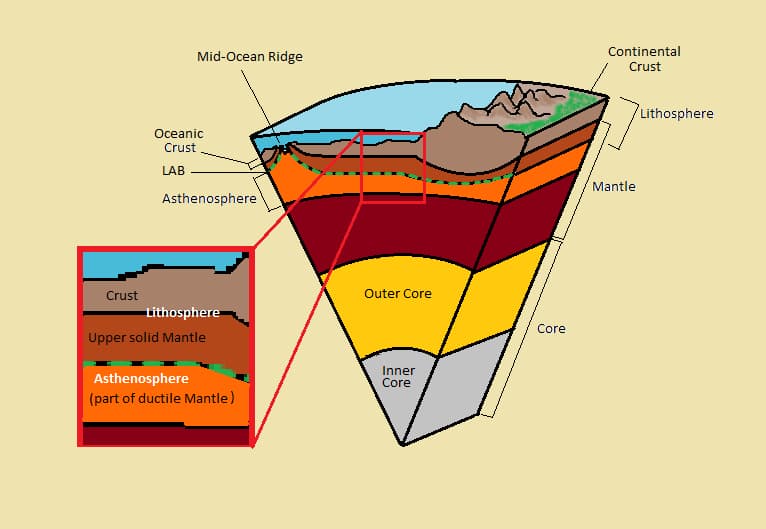
Despite being the second layer of the Earth, it is actually the largest layer amongst the 4, being 2900 kilometers thick. It makes up around 84% of the Earth’s total volume, and there are several layers. Those are the upper mantle, the transition zone, the lower mantle, and the D” (D double-prime, where the mantle meets the outer core. The mantle consists of very hot and dense rock that flows like asphalt under a heavy weight. The upper part consists of heavy rocks in solid form, and the rocks become softer deeper down as the temperature is higher. There are two parts of the upper mantle: the lithosphere and the asthenosphere.
The movement of the mantle is the reason that the plates of the Earth move. It plays a crucial role in geological processes such as earthquakes, mountain formation, and volcanic eruptions due to the movement of tectonic plates. Mantle convection describes the movement of the mantle as it transfers heat from the white-hot core to the brittle lithosphere. Also, the mantle is heated from below and cooled from above. Many geologists believe that the mantle flows because of “convection currents”. This phenomenon is caused by the very hot material at the deepest part of the mantle rising, then cooling, and sinking. Then, it heats again so it rises up, and the cycle repeats over and over. If we talk about temperature, it is about 980 to 2200 degrees celsius hot.
The mantle has never been directly explored because even the most sophisticated drilling equipment has not reached beyond the crust yet. Many geologists study the mantle by analyzing xenoliths, the type of rock trapped inside another rock. The xenoliths that provide the most information about the mantle are diamonds, and they are from the upper mantle.
3Outer Core

The outer core of the Earth is around 2900 kilometers beneath the crust, and about 2260 kilometers thick. This layer makes up about 30% of the Earth’s mass, and it is composed of the melted metals nickel and iron. It is so hot that the metals in it are all in liquid form. How hot? The core of the Earth is like a ball of extremely hot metal, being 2200 to 5000 degrees Celsius. Earth’s core is always moving, and the flow in the outer core is the reason for the formation of a magnetic field on Earth. When the outer core’s liquid metals shift and rotate, the movement can change the location of the magnetic North and South poles.
The outer core is like a site of violent convection. Also, the churning metal of the outer core creates and sustains the Earth’s magnetic field. This magnetic field extends from the outer core through the mantle, crust, and the atmosphere of the planet. It also protects all life on Earth. Without the outer core, life would be very different. The magnetic field extends outward from the Earth for several thousand kilometers, and creates a protective bubble around the Earth. This bubble deflects the Sun’s solar wind from blasting away our atmosphere. And without this protective bubble, Earth would be as dead and lifeless just like Mars; if Martians were actually non-existent.
4Inner Core
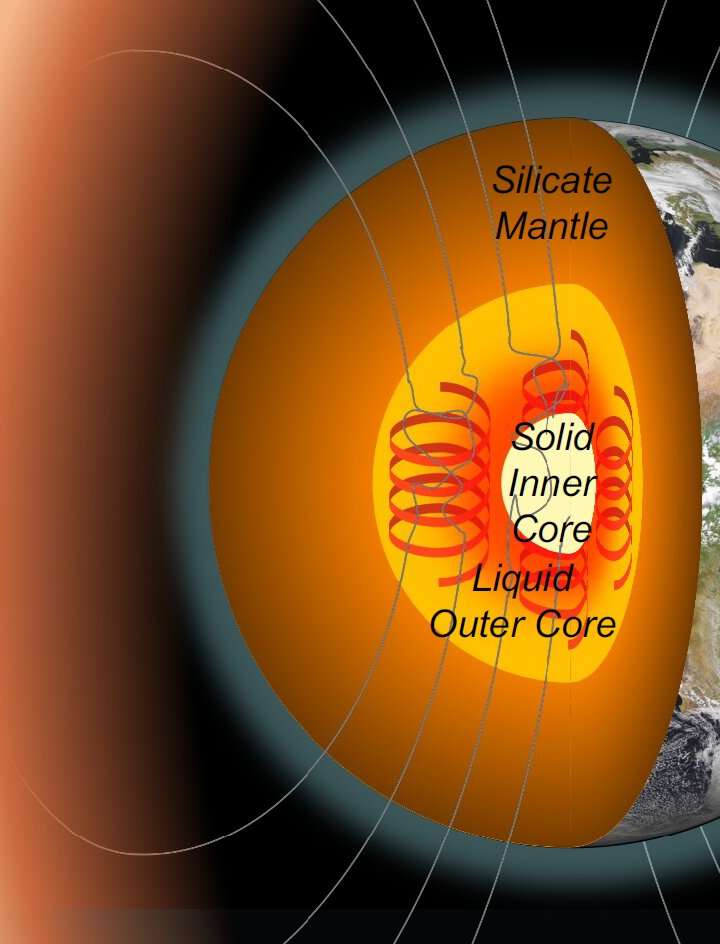
The inner core is 6500 kilometers beneath the crust, and it is about 1300 kilometers thick. This layer is a spheroid, but not a perfect sphere. It is also very hot there, reaching 5000 degrees Celsius. As for the inner core, it is also mainly composed of iron and nickel. It is a hot and dense ball of (mostly) iron. Things are more tense on the inner core of the Earth, as both the pressures and temperatures are so great. The temperature of the inner core is actually far above the melting point of iron. Unlike the outer core, the pressure of the inner core is so intense it prevents the iron from melting.
This inner core is the innermost layer of the Earth, and it helps generate the Earth’s magnetic field. It does so through interactions with the outer core. This global magnetic field shields life from solar and cosmic radiation, protecting life on Earth. Despite being solid, the inner core is not permanently fixed in place. It may rotate at a slightly different rate than the rest of the Earth, and can distort under pressure. What’s interesting is that the inner core may have multiple layers of its own: “the innermost inner core”. Being so far from the surface, plus limited technology, there is still a lot to study about the inner core. Perhaps in the future, there will be more methods and technologies that allow us to know more about this layer.
Related Post: Things To Know About Radioactive Waste